
本页面面向插件作者。如果你想在 Codex 中浏览、安装和使用插件,请参见 Plugins。如果你仍在迭代一个仓库或一个个人工作流,请从本地 skill 开始。当你想在团队之间共享该工作流、打包 app 集成或 MCP 配置、打包生命周期 hooks,或发布一个稳定包时,再构建插件。
使用 @plugin-creator 创建插件
Section titled “使用 @plugin-creator 创建插件”最快的设置方式是使用内置的 @plugin-creator skill。
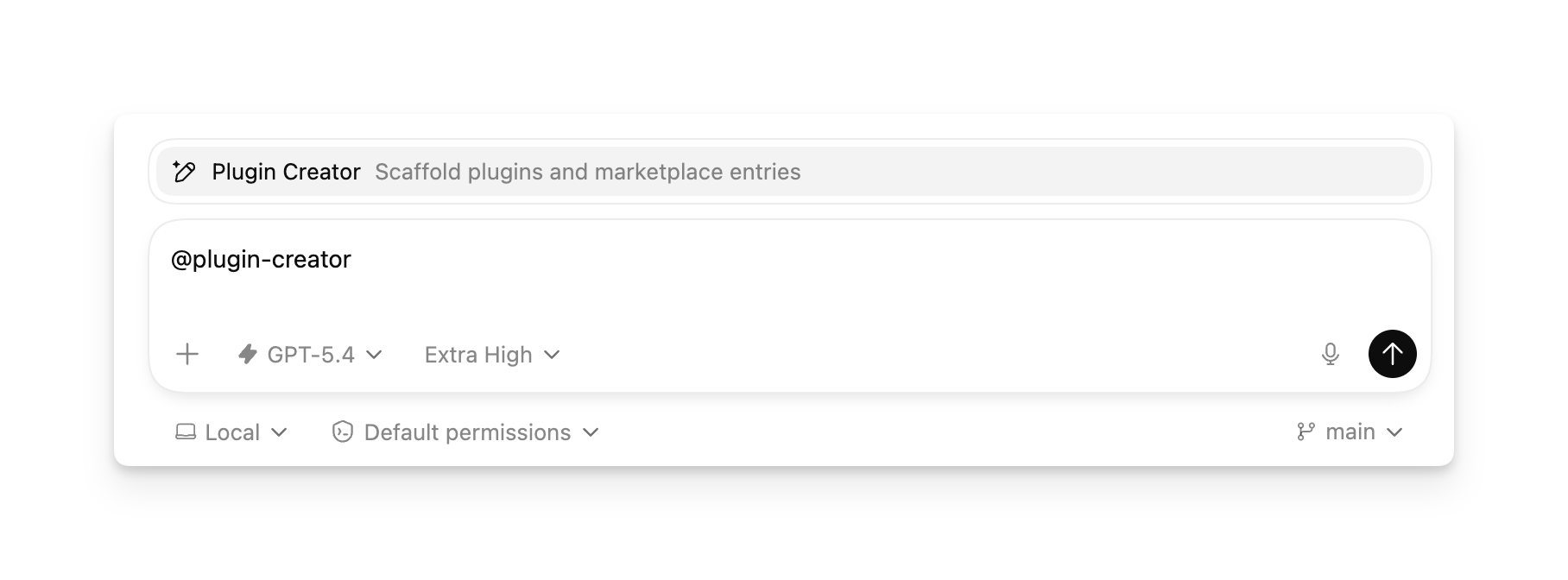
它会搭建所需的 .codex-plugin/plugin.json manifest,也可以生成一个用于测试的本地 marketplace 条目。如果你已经有一个插件文件夹,仍然可以使用 @plugin-creator 将它接入本地 marketplace。
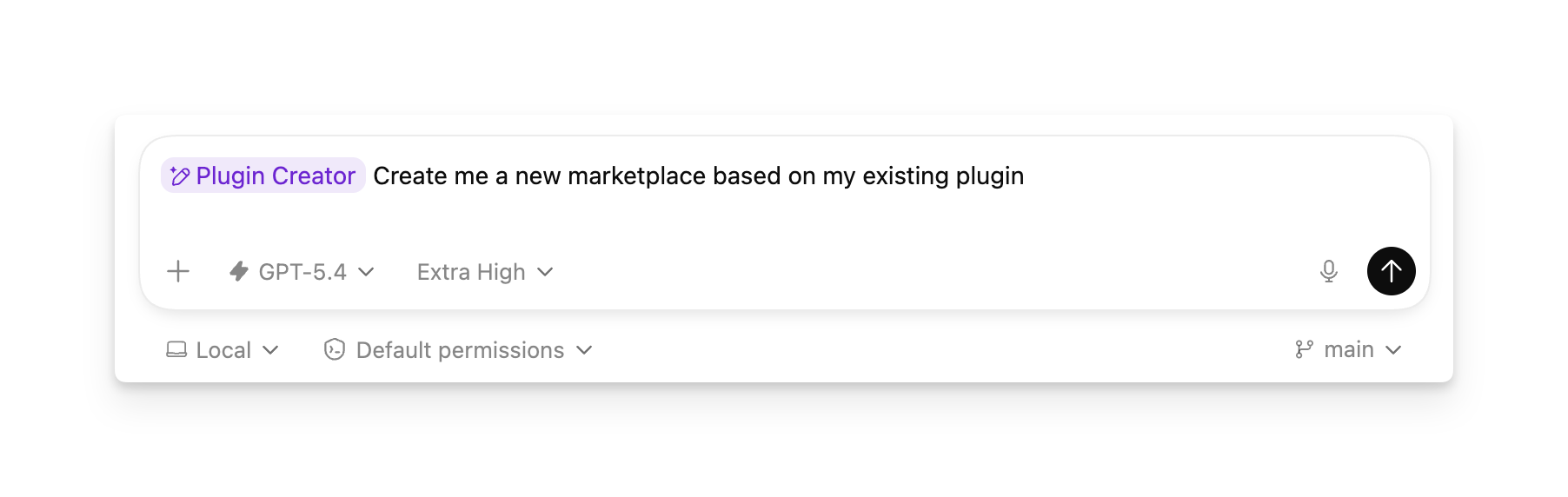
构建你自己的精选插件列表
Section titled “构建你自己的精选插件列表”marketplace 是一个插件的 JSON 目录。@plugin-creator 可以为单个插件生成一个 marketplace,你也可以继续向同一个 marketplace 添加条目,为仓库、团队或个人工作流构建自己的精选列表。
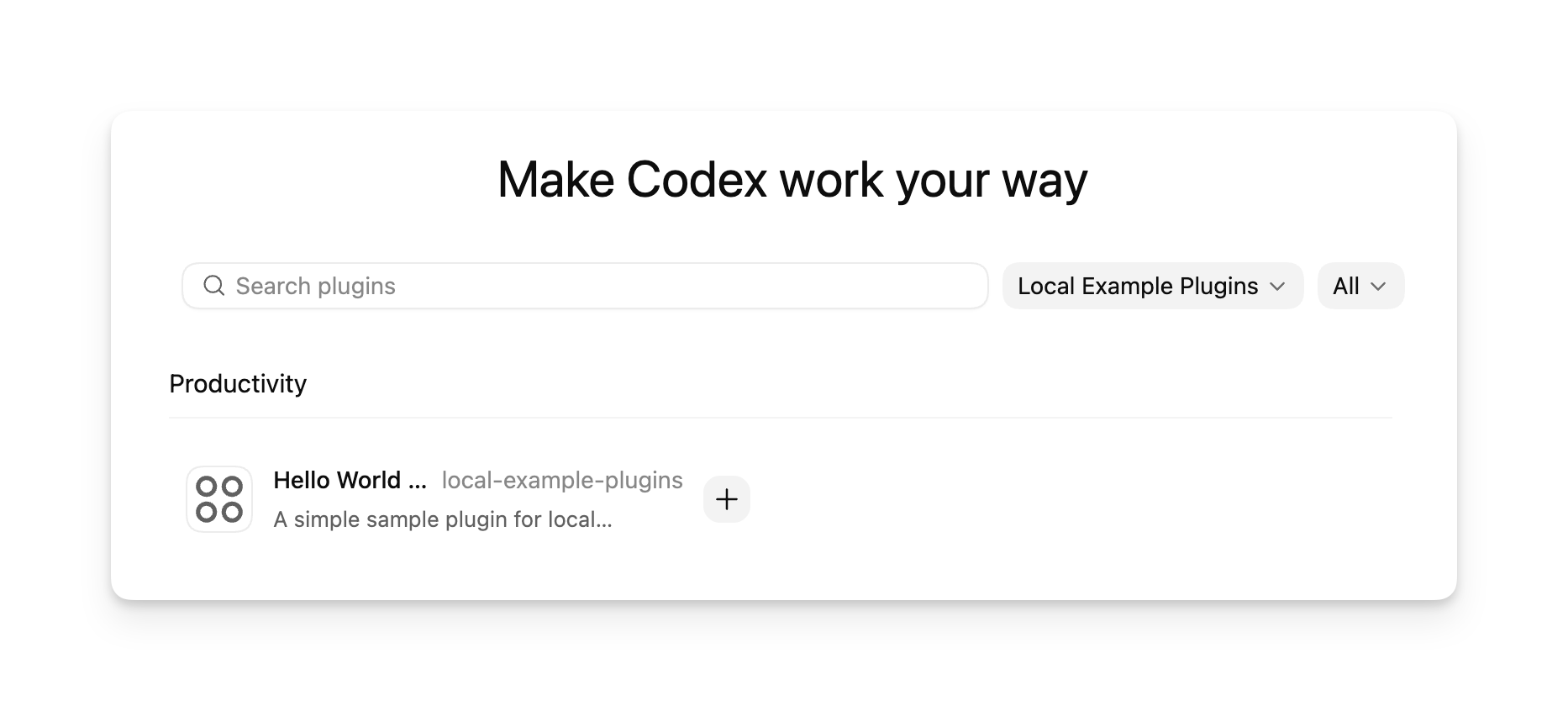
在 Codex 中,每个 marketplace 都会在插件目录中显示为一个可选择的来源。仓库范围的列表使用 $REPO_ROOT/.agents/plugins/marketplace.json,个人列表使用 ~/.agents/plugins/marketplace.json。在 plugins[] 下为每个插件添加一个条目,将每个 source.path 指向插件文件夹,路径应以 ./ 开头并相对于 marketplace 根目录,然后将 interface.displayName 设置为你希望 Codex 在 marketplace 选择器中显示的标签。然后重启 Codex。之后,打开插件目录,选择你的 marketplace,并浏览或安装该精选列表中的插件。
你不需要为每个插件创建单独的 marketplace。一个 marketplace 可以在测试时暴露单个插件,然后随着你添加更多插件,逐渐发展为更大的精选目录。
从 CLI 添加 marketplace
Section titled “从 CLI 添加 marketplace”当你希望 Codex 为你安装和跟踪 marketplace 来源,而不是手动编辑 config.toml 时,请使用 codex plugin marketplace add。
codex plugin marketplace add owner/repocodex plugin marketplace add owner/repo --ref maincodex plugin marketplace add https://github.com/example/plugins.git --sparse .agents/pluginscodex plugin marketplace add ./local-marketplace-rootMarketplace 来源可以是 GitHub 简写形式(owner/repo 或 owner/repo@ref)、HTTP 或 HTTPS Git URL、SSH Git URL,或本地 marketplace 根目录。使用 --ref 固定一个 Git ref,并重复使用 --sparse PATH 为基于 Git 的 marketplace 仓库使用 sparse checkout。--sparse 仅对 Git marketplace 来源有效。
要检查、刷新或移除已配置的 marketplaces:
codex plugin marketplace listcodex plugin marketplace upgradecodex plugin marketplace upgrade marketplace-namecodex plugin marketplace remove marketplace-namecodex plugin marketplace list 会打印 Codex 正在考虑的每个 marketplace,以及它解析出的根路径,包括本地默认 marketplaces 和已配置的 marketplace 快照。
手动创建插件
Section titled “手动创建插件”从一个打包一个 skill 的最小插件开始。
- 创建一个插件文件夹,并在
.codex-plugin/plugin.json放置 manifest。
mkdir -p my-first-plugin/.codex-pluginmy-first-plugin/.codex-plugin/plugin.json
{ "name": "my-first-plugin", "version": "1.0.0", "description": "Reusable greeting workflow", "skills": "./skills/"}使用稳定的 kebab-case 格式插件 name。Codex 会将它用作插件标识符和组件命名空间。
- 在
skills/<skill-name>/SKILL.md下添加一个 skill。
mkdir -p my-first-plugin/skills/hellomy-first-plugin/skills/hello/SKILL.md
---name: hellodescription: Greet the user with a friendly message.---
Greet the user warmly and ask how you can help.- 将插件添加到 marketplace。使用
@plugin-creator生成一个,或按照 构建你自己的精选插件列表 手动将插件接入 Codex。
从这里开始,你可以根据需要添加 MCP 配置、app 集成或 marketplace 元数据。
手动安装本地插件
Section titled “手动安装本地插件”根据谁应该能够访问该插件或精选列表,使用仓库 marketplace 或个人 marketplace。
在 $REPO_ROOT/.agents/plugins/marketplace.json 添加一个 marketplace 文件,并将你的插件存放在 $REPO_ROOT/plugins/ 下。
仓库 marketplace 示例
步骤 1:将插件文件夹复制到 $REPO_ROOT/plugins/my-plugin。
mkdir -p ./pluginscp -R /absolute/path/to/my-plugin ./plugins/my-plugin步骤 2:添加或更新 $REPO_ROOT/.agents/plugins/marketplace.json,使 source.path 以 ./ 开头的相对路径指向该插件目录:
{ "name": "local-repo", "plugins": [{ "name": "my-plugin", "source": { "source": "local", "path": "./plugins/my-plugin"}, "policy": { "installation": "AVAILABLE", "authentication": "ON_INSTALL"}, "category": "Productivity"} ]}步骤 3:重启 Codex,并验证插件是否出现。
在 ~/.agents/plugins/marketplace.json 添加一个 marketplace 文件,并将你的插件存放在 ~/.codex/plugins/ 下。
个人 marketplace 示例
步骤 1:将插件文件夹复制到 ~/.codex/plugins/my-plugin。
mkdir -p ~/.codex/pluginscp -R /absolute/path/to/my-plugin ~/.codex/plugins/my-plugin步骤 2:添加或更新 ~/.agents/plugins/marketplace.json,使插件条目的 source.path 指向该目录。
步骤 3:重启 Codex,并验证插件是否出现。
marketplace 文件指向插件位置,因此这些目录只是示例,而不是固定要求。Codex 会相对于 marketplace 根目录解析 source.path,而不是相对于 .agents/plugins/ 文件夹解析。文件格式请参见 Marketplace 元数据。
更改插件后,请更新 marketplace 条目所指向的插件目录,并重启 Codex,以便本地安装获取新文件。
与你的 workspace 共享本地插件
Section titled “与你的 workspace 共享本地插件”创建插件并将其添加到 Codex 后,你可以从 Codex app 将其共享给 ChatGPT workspace 的其他成员。
- 在 Codex app 中打开 Plugins。
- 前往 Created by you,并打开插件详情页。
- 选择 Share。
- 添加 workspace 成员或 workspace 组,或复制分享链接。
- 选择谁有访问权限,然后发送邀请或链接。
被你共享的人可以在插件目录中的 Shared with you 下找到该插件。将本地插件共享给你的 workspace 不会将它发布到公共 Plugin Directory。共享插件会保留在你的 workspace 和组织边界内;未登录该 workspace 的账户无法访问它。当一个团队或角色应共享相同插件访问权限时,请使用 groups。当你希望通过仓库或 CLI 分发时,请使用 marketplace;当你希望选定的队友从 Codex app 安装插件时,请使用 workspace sharing。
Workspace 管理员可以通过在 requirements.toml 中添加 features.plugin_sharing = false,从 cloud-managed requirements 禁用插件共享:
features.plugin_sharing = falseMarketplace 元数据
Section titled “Marketplace 元数据”如果你维护一个仓库 marketplace,请在 $REPO_ROOT/.agents/plugins/marketplace.json 中定义它。对于个人 marketplace,请使用 ~/.agents/plugins/marketplace.json。marketplace 文件控制 Codex 面向目录中的插件排序和安装策略。它可以在你测试时表示一个插件,也可以表示你希望 Codex 在一个 marketplace 名称下共同展示的精选插件列表。在将插件添加到 marketplace 之前,请确保它的 version、publisher 元数据和安装界面文案已经准备好让其他开发者看到。
{ "name": "local-example-plugins", "interface": { "displayName": "Local Example Plugins" }, "plugins": [ { "name": "my-plugin", "source": { "source": "local", "path": "./plugins/my-plugin" }, "policy": { "installation": "AVAILABLE", "authentication": "ON_INSTALL" }, "category": "Productivity" }, { "name": "research-helper", "source": { "source": "local", "path": "./plugins/research-helper" }, "policy": { "installation": "AVAILABLE", "authentication": "ON_INSTALL" }, "category": "Productivity" } ]}- 使用顶层
name标识 marketplace。 - 使用
interface.displayName作为 Codex 中显示的 marketplace 标题。 - 在
plugins下为每个插件添加一个对象,以构建 Codex 在该 marketplace 标题下显示的精选列表。 - 将每个插件条目的
source.path指向你希望 Codex 加载的插件目录。对于仓库安装,通常位于./plugins/下。对于个人安装,常见模式是./.codex/plugins/<plugin-name>。 - 保持
source.path相对于 marketplace 根目录,以./开头,并保持在该根目录内部。 - 对于本地条目,
source也可以是普通字符串路径,例如"./plugins/my-plugin"。 - 始终在每个插件条目上包含
policy.installation、policy.authentication和category。 - 使用
policy.installation值,例如AVAILABLE、INSTALLED_BY_DEFAULT或NOT_AVAILABLE。 - 使用
policy.authentication决定认证是在安装时发生,还是在首次使用时发生。
marketplace 控制 Codex 从哪里加载插件。如果你的插件位于这些示例目录之外,本地 source.path 可以指向其他位置。marketplace 文件可以位于你开发插件的仓库中,也可以位于单独的 marketplace 仓库中,并且一个 marketplace 文件可以指向一个插件或多个插件。
Marketplace 条目也可以指向基于 Git 的插件来源。当插件位于仓库根目录时,使用 "source": "url";当插件位于子目录中时,使用 "source": "git-subdir":
{ "name": "remote-helper", "source": { "source": "git-subdir", "url": "https://github.com/example/codex-plugins.git", "path": "./plugins/remote-helper", "ref": "main" }, "policy": { "installation": "AVAILABLE", "authentication": "ON_INSTALL" }, "category": "Productivity"}基于 Git 的条目可以使用 ref 或 sha 选择器。如果 Codex 无法解析某个 marketplace 条目的来源,它会跳过该插件条目,而不是让整个 marketplace 失败。
Codex 如何使用 marketplaces
Section titled “Codex 如何使用 marketplaces”插件 marketplace 是一个 JSON 插件目录,Codex 可以读取和安装。
Codex 可以从以下位置读取 marketplace 文件:
- 驱动官方 Plugin Directory 的精选 marketplace
$REPO_ROOT/.agents/plugins/marketplace.json下的仓库 marketplace$REPO_ROOT/.claude-plugin/marketplace.json下的兼容旧版 marketplace~/.agents/plugins/marketplace.json下的个人 marketplace
你可以安装通过 marketplace 暴露的任何插件。Codex 会将插件安装到 ~/.codex/plugins/cache/$MARKETPLACE_NAME/$PLUGIN_NAME/$VERSION/。对于本地插件,$VERSION 为 local,Codex 会从该缓存路径加载已安装副本,而不是直接从 marketplace 条目加载。
你可以单独启用或禁用每个插件。Codex 会在 ~/.codex/config.toml 中存储每个插件的开启或关闭状态。
打包和分发插件
Section titled “打包和分发插件”每个插件都有一个 manifest,位于 .codex-plugin/plugin.json。它也可以包含 skills/ 目录、用于生命周期 hooks 的 hooks/ 目录、指向一个或多个 apps 或 connectors 的 .app.json 文件、配置 MCP servers 的 .mcp.json 文件,以及用于在受支持界面中展示插件的 assets。
Directory
my-plugin/Directory
.codex-plugin/plugin.json必需:插件 manifest
Directory
skills/Directory
my-skill/SKILL.md可选:skill instructions
Directory
hooks/hooks.json可选:生命周期 hooks
.app.json可选:app 或 connector mappings.mcp.json可选:MCP server configurationDirectory
assets/可选:icons、logos、screenshots- …
只有 plugin.json 属于 .codex-plugin/。将 skills/、hooks/、assets/、.mcp.json 和 .app.json 保持在插件根目录。
已发布的插件通常使用比快速开始脚手架中最小示例更丰富的 manifest。manifest 有三个作用:
- 标识插件。
- 指向打包的组件,例如 skills、apps、MCP servers 或 hooks。
- 提供安装界面元数据,例如 descriptions、icons 和 legal links。
下面是一个完整的 manifest 示例:
{ "name": "my-plugin", "version": "0.1.0", "description": "Bundle reusable skills and app integrations.", "author": { "name": "Your team", "email": "team@example.com", "url": "https://example.com" }, "homepage": "https://example.com/plugins/my-plugin", "repository": "https://github.com/example/my-plugin", "license": "MIT", "keywords": ["research", "crm"], "skills": "./skills/", "mcpServers": "./.mcp.json", "apps": "./.app.json", "hooks": "./hooks/hooks.json", "interface": { "displayName": "My Plugin", "shortDescription": "Reusable skills and apps", "longDescription": "Distribute skills and app integrations together.", "developerName": "Your team", "category": "Productivity", "capabilities": ["Read", "Write"], "websiteURL": "https://example.com", "privacyPolicyURL": "https://example.com/privacy", "termsOfServiceURL": "https://example.com/terms", "defaultPrompt": [ "Use My Plugin to summarize new CRM notes.", "Use My Plugin to triage new customer follow-ups." ], "brandColor": "#10A37F", "composerIcon": "./assets/icon.png", "logo": "./assets/logo.png", "screenshots": ["./assets/screenshot-1.png"] }}.codex-plugin/plugin.json 是必需入口点。其他 manifest 字段是可选的,但已发布插件通常会使用它们。
Manifest 字段
Section titled “Manifest 字段”使用顶层字段定义包元数据并指向打包组件:
name、version和description标识插件。author、homepage、repository、license和keywords提供 publisher 和 discovery 元数据。skills、mcpServers、apps和hooks指向相对于插件根目录的打包组件。interface控制安装界面如何展示插件。
使用 interface 对象定义安装界面元数据:
displayName、shortDescription和longDescription控制标题和描述性文案。developerName、category和capabilities添加 publisher 和 capability 元数据。websiteURL、privacyPolicyURL和termsOfServiceURL提供外部链接。defaultPrompt、brandColor、composerIcon、logo和screenshots控制 starter prompts 和视觉展示。
- 保持 manifest 路径相对于插件根目录,并以
./开头。 - 尽可能将视觉 assets,例如
composerIcon、logo和screenshots,存放在./assets/下。 - 使用
skills表示打包的 skill 文件夹,使用apps表示.app.json,使用mcpServers表示.mcp.json,使用hooks表示生命周期 hooks。 - 启用的插件可以在 skills、MCP servers 和 apps 旁包含生命周期 hooks。
- 如果你的插件将 hooks 存储在
./hooks/hooks.json,则不需要在.codex-plugin/plugin.json中添加hooks条目;Codex 会自动检查该默认文件。
打包的 MCP servers 和生命周期 hooks
Section titled “打包的 MCP servers 和生命周期 hooks”mcpServers 可以指向一个 .mcp.json 文件,该文件包含直接的 server map 或包装的 mcp_servers 对象。
直接 server map:
{ "docs": { "command": "docs-mcp", "args": ["--stdio"] }}包装的 server map:
{ "mcp_servers": { "docs": { "command": "docs-mcp", "args": ["--stdio"] } }}安装后,用户可以从他们的 Codex 配置中启用或禁用打包的 MCP server,并调整工具审批策略,而无需编辑插件。对插件范围的 MCP server 策略使用 plugins.<plugin>.mcp_servers.<server>:
[plugins."my-plugin".mcp_servers.docs]enabled = truedefault_tools_approval_mode = "prompt"enabled_tools = ["search"]
[plugins."my-plugin".mcp_servers.docs.tools.search]approval_mode = "approve"
当你的插件被启用时,Codex 可以在用户、项目和 managed hooks 旁加载来自插件的生命周期 hooks。
安装或启用插件不会自动信任它的 hooks。插件打包的 hooks 是非 managed hooks,因此 Codex 会跳过它们,直到用户审查并信任当前 hook 定义。
默认插件 hook 文件是 hooks/hooks.json:
{ "hooks": { "SessionStart": [ { "hooks": [ { "type": "command", "command": "python3 ${PLUGIN_ROOT}/hooks/session_start.py", "statusMessage": "Loading plugin context" } ] } ] }}如果你在 .codex-plugin/plugin.json 中定义了 hooks,Codex 会使用该 manifest 条目,而不是默认的 hooks/hooks.json。manifest 字段可以是单个路径、路径数组、内联 hooks 对象,或内联 hooks 对象数组。
{ "name": "repo-policy", "hooks": ["./hooks/session.json", "./hooks/tools.json"]}Hook 路径遵循与 skills、apps 和 mcpServers 相同的 manifest 路径规则:以 ./ 开头,相对于插件根目录解析,并保持在插件根目录内。
插件 hook 命令会接收 Codex 特定环境变量 PLUGIN_ROOT 和 PLUGIN_DATA。PLUGIN_ROOT 指向已安装插件根目录,PLUGIN_DATA 指向插件的可写数据目录。为了兼容已有插件 hooks,Codex 也会设置 CLAUDE_PLUGIN_ROOT 和 CLAUDE_PLUGIN_DATA。
插件 hooks 使用与常规 hooks 相同的事件 schema。有关受支持事件、输入、输出、信任审查和当前限制,请参见 Hooks。
发布官方公共插件
Section titled “发布官方公共插件”将插件添加到官方 Plugin Directory 即将推出。
自助式插件发布和管理即将推出。